Sports safety nets are an essential part of modern sports infrastructure. They are used around cricket grounds, football turfs, badminton courts, golf facilities, practice areas, schools, academies, and multi sport facilities to improve safety and prevent balls from leaving the playing area.
As sports infrastructure continues to expand across India, the demand for durable and customized sports netting has increased. However, not all sports safety nets are manufactured in the same way. The quality of the raw material, net construction, mesh size, knotting or weaving technique, UV protection, finishing, and installation method can all affect the final performance of the net.
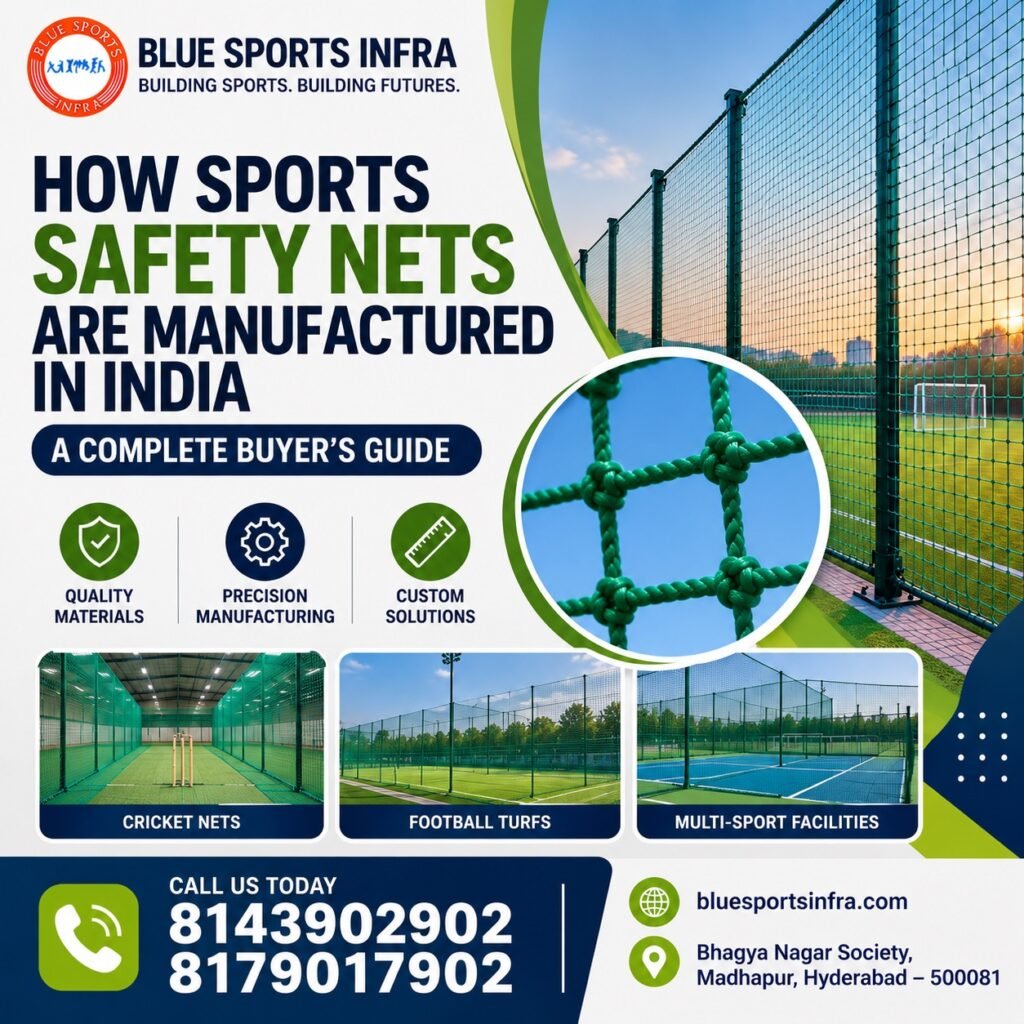
For sports facility owners, contractors, schools, academies, and developers, understanding how sports safety nets are manufactured makes it easier to select the right product for a specific application. Blue Sports Infra provides sports netting and complete sports infrastructure solutions for facilities across India, with customized options based on the requirements of each project.
What Are Sports Safety Nets?
Sports safety nets are protective netting systems designed to contain balls within a designated playing or practice area. They are commonly installed around sports grounds, behind goalposts, above playing areas, and along the boundaries of courts and practice facilities.
The netting allows players and spectators to maintain visibility while creating a protective barrier around the sports area. Depending on the application, sports nets can be manufactured in different mesh sizes, thicknesses, colors, dimensions, and strengths.
Common applications include
- Cricket practice nets
- Football turf netting
- Badminton court nets
- Golf practice nets
- Multi sport facilities
- School sports grounds
- Sports academies
- Indoor sports facilities
- Residential sports areas
- Commercial sports complexes
The correct specification depends on the sport, ball speed, installation height, surrounding environment, and expected level of usage.
Materials Used to Manufacture Sports Safety Nets
The raw material is one of the most important factors determining the durability of a sports safety net. Manufacturers generally use strong synthetic materials that can withstand repeated impact and environmental exposure.
Polyethylene is widely used for sports netting because it provides a useful combination of strength, flexibility, lightweight construction, and weather resistance. Depending on the application, manufacturers can use different grades, thicknesses, and configurations.
For outdoor sports facilities, UV resistance is particularly important. Continuous exposure to sunlight can gradually weaken low quality materials. UV stabilized materials are therefore preferred for installations that remain outdoors throughout the year.
The material selection should consider
- Sport and ball type
- Indoor or outdoor application
- Expected impact frequency
- UV exposure
- Weather conditions
- Required service life
- Installation location
How Sports Netting Is Manufactured
The manufacturing process begins with the selection and preparation of the raw material. Synthetic material is processed into suitable yarn or strands depending on the required specifications.
The yarn is then converted into netting through specialized manufacturing processes. Depending on the product design, the net may be produced using knotless or knotted construction.
During manufacturing, the dimensions, mesh pattern, thickness, and overall consistency of the net are controlled to ensure that the finished product meets the required specifications.
Once the main netting has been produced, the edges may be reinforced to improve strength and provide secure attachment points. Additional ropes, borders, loops, or fixing arrangements can be incorporated depending on the installation requirements.
The final product is then inspected before being prepared for delivery and installation.
Understanding Mesh Size
Mesh size is one of the most important specifications when purchasing sports safety nets. The correct mesh size depends on the sport and the type of ball that needs to be contained.
A smaller mesh may be required for applications involving smaller or faster moving objects, while larger mesh configurations may be suitable for other sports applications.
The manufacturer should evaluate the intended use before recommending the appropriate mesh configuration.
Sports facilities should avoid selecting netting based only on appearance or price. The mesh should be appropriate for the actual playing conditions and expected impact.
Net Thickness and Strength
The thickness and construction of the netting influence its ability to withstand repeated impact. A practice cricket facility, for example, may experience frequent ball impact throughout the day, requiring durable netting designed for continuous use.
Commercial facilities with high player volumes should generally prioritize durability and long term performance rather than selecting the lowest priced option.
Important factors include
- Yarn thickness
- Net construction
- Overall strength
- Impact resistance
- UV stability
- Edge reinforcement
- Expected frequency of use
A professional supplier can recommend an appropriate specification based on the facility’s actual requirements.
Importance of UV Stabilization
Outdoor sports nets are exposed to sunlight for long periods. Ultraviolet radiation can gradually affect synthetic materials, particularly when low quality products are used.
UV stabilized sports nets are designed to provide better resistance to prolonged sunlight exposure. This can be particularly important for cricket grounds, football turfs, golf practice areas, and outdoor academies.
When purchasing outdoor sports netting, buyers should ask about UV stabilization and suitability for long term outdoor use.
Custom Sports Safety Nets
One of the major advantages of working with an experienced manufacturer or supplier is the ability to customize the net according to the project.
Sports facilities rarely have identical dimensions. Some installations may require large overhead nets, while others may require narrow side barriers or specially shaped sections.
Custom manufacturing can accommodate
- Specific length and width
- Different mesh sizes
- Different yarn thicknesses
- Custom colors
- Reinforced edges
- Special fixing arrangements
- Large area installations
- Irregular shapes
Customized netting helps create a better fit and can reduce unnecessary overlaps or gaps during installation.
Sports Safety Nets for Cricket Facilities
Cricket is one of the largest applications for sports safety netting in India. Cricket academies and practice facilities require nets around batting and bowling areas to prevent balls from travelling outside the designated practice zone.
Cricket nets need to withstand repeated impact while providing sufficient visibility for players and coaches.
Important considerations include the height of the net, mesh configuration, support structure, fixing method, and expected usage.
Blue Sports Infra provides professional cricket net solutions for indoor and outdoor sports facilities.
Sports Nets for Football and Multi Sport Facilities
Football turfs and multi sport facilities also require protective netting around the playing area. The net helps keep the ball within the facility while improving safety for spectators and surrounding property.
The height and configuration can vary depending on the facility layout. Commercial football turfs may require stronger and taller netting because of frequent usage and high ball impact.
For facilities supporting multiple sports, the netting should be selected according to the most demanding application.
Blue Sports Infra also provides multi sport artificial turf and sports infrastructure solutions for facilities that accommodate different sporting activities.
Quality Inspection During Manufacturing
Quality control is an important part of sports net manufacturing. Before the product reaches the customer, manufacturers should check the net for consistency, dimensions, finishing, and visible defects.
Important quality checks may include
- Mesh uniformity
- Net dimensions
- Yarn consistency
- Edge finishing
- Knot or joining quality
- Physical strength
- UV resistance specifications
- Overall appearance
The exact testing requirements can vary depending on the intended application and product specifications.
Buyers should request relevant product specifications from the supplier before placing large orders.
Importance of Edge Reinforcement
The edges of a sports net experience significant stress because they are connected to the supporting structure. Properly reinforced edges help distribute tension and reduce the possibility of premature damage.
Depending on the application, manufacturers may incorporate reinforced borders, ropes, loops, or other fixing arrangements.
For large installations, edge construction becomes particularly important because the net may be under continuous tension.
How Sports Safety Nets Are Installed
Manufacturing is only one part of the process. Correct installation is equally important for the performance and durability of a sports safety net.
Installation typically involves site measurement, support structure preparation, positioning of the net, fixing, tensioning, and final inspection.
The installation system depends on whether the net is being fixed to poles, cables, walls, frames, or other supporting structures.
Professional installation helps ensure that the net remains properly tensioned and does not develop unnecessary stress points.
Factors to Consider Before Buying Sports Safety Nets
Sports facility owners should evaluate several factors before purchasing safety netting.
Consider
- Type of sport
- Indoor or outdoor installation
- Required net dimensions
- Mesh size
- Yarn thickness
- UV resistance
- Expected usage
- Support structure
- Installation requirements
- Maintenance needs
- Supplier experience
Selecting the right specification at the beginning can reduce replacement costs and improve the overall lifespan of the installation.
Why Choose Blue Sports Infra
Blue Sports Infra provides sports infrastructure and netting solutions for schools, sports academies, clubs, commercial facilities, residential communities, and other organizations across India.
The company focuses on providing solutions based on the actual requirements of each facility rather than using a standard approach for every project.
Blue Sports Infra can support requirements related to
- Sports safety nets
- Cricket practice nets
- Artificial turf
- Football turf
- Multi sport facilities
- Sports court construction
- Netting installation
- Sports infrastructure maintenance
For organizations planning a complete sports facility, Blue Sports Infra also provides sports infrastructure services covering multiple indoor and outdoor sports applications.
Maintenance of Sports Safety Nets
Even durable sports netting requires periodic inspection and maintenance. Regular checks can help identify small issues before they become larger problems.
Maintenance should include inspection for
- Torn or damaged sections
- Loose fixing points
- Excessive sagging
- Damaged support ropes
- UV related deterioration
- Dirt and debris accumulation
- Structural issues around support poles
Sports facilities with heavy daily usage should conduct inspections more frequently to maintain safety and performance.
Common Mistakes When Buying Sports Nets
One of the most common mistakes is selecting a sports net based only on price. Low cost netting may not provide the strength, UV resistance, or durability required for continuous commercial use.
Other common mistakes include choosing the wrong mesh size, ignoring the support structure, failing to account for outdoor weather exposure, and using inexperienced installers.
A professional assessment before purchasing can help avoid these problems.
Why Professional Manufacturing Matters
Sports safety nets are protective infrastructure and should be selected according to the actual requirements of the facility. Professional manufacturing allows the product to be designed with appropriate materials, dimensions, mesh configuration, and finishing.
For large sports facilities, customized manufacturing can also help ensure that the net integrates correctly with the supporting structure and overall facility design.
Working with an experienced sports infrastructure company provides additional advantages because the supplier can consider the netting as part of the complete sports facility rather than as an isolated product.
Conclusion
Sports safety nets are an essential component of modern sports infrastructure across India. From cricket academies and football turfs to schools, commercial sports facilities, and multi sport complexes, professionally manufactured netting helps improve safety while keeping the playing area functional and organized.
The quality of a sports safety net depends on several factors, including the raw material, mesh size, yarn thickness, UV resistance, edge reinforcement, manufacturing quality, and installation method. Choosing the correct specification for the intended application is essential for achieving long term performance.
Blue Sports Infra provides sports netting and complete sports infrastructure solutions tailored to the requirements of different facilities. With appropriate product selection, professional installation, and regular maintenance, sports safety nets can provide reliable protection and long lasting performance for sports facilities across India.